
The Science of "Ums" and "Likes": Why editing out filler words is backed by linguistics (and a workflow hack to do it in seconds)
If you’ve spent any time editing audio or video lately, you know that completely purging "ums," "uhs," "likes," and "you knows" is standard advice. Public speaking coaches tell us they make us sound nervous, and platforms promise one-click AI fixes.
But as content consumption shifts to highly captive, premium audio formats, what does the actual science say about how these verbal habits impact an audience? And more importantly, how do you fix them without destroying your workflow or making yourself sound like a sterile robot?
Here is a look at the real data behind speech disfluencies, and how you can seamlessly fix them.
1. The Real Cost to Professional Credibility
While some argue that filler words are completely harmless, peer-reviewed academic research shows they take a measurable toll on how an audience judges your intelligence and authority.
In a study published via ResearchGate, The Effect of Vocal Fillers on Credibility, Communication Competence, and Likeability, researchers explicitly tracked how an audience reacts when speech disfluencies are present versus when they are absent.
The Impact: A high volume of filler words significantly degrades a speaker’s perceived professional credibility, personal credibility, and overall communication competence.
The Gender Bias: While the negative impact applied across the board, the study revealed that male listeners judge vocal fillers significantly more harshly than female listeners do. If your audience or industry includes male corporate decision-makers, heavy filler usage actively undermines your pitch.
2. The High Expectations of the Audio Audience
Why do filler words stand out so much more in a modern podcast or video essay than they do in a standard phone call? It comes down to the listening environment.
According to Edison Research’s comprehensive The Podcast Consumer Report, modern media consumers expect a premium, low-intrusion experience.
The Metric: Edison found that 46% of monthly podcast listeners consider podcast ads "not at all intrusive"—making podcasts the least intrusive ad medium available, beating out YouTube (23%), television, and radio.
The Takeaway: Because audiences approach digital audio/video expecting an incredibly seamless, intimate experience, repetitive speech disfluencies stand out aggressively. They disrupt the premium flow of a medium where consumers are already primed to give you their undivided attention.
3. The Cognitive Reality: Why Your Brain Does It
To understand how to edit filler words effectively, you have to understand why we say them. On an episode of Stanford Graduate School of Business's podcast, “Um, Like, So”: How Filler Words Can Be Effective in Communication, sociolinguist Valerie Fridland broke down the actual cognitive purpose of these pauses.
The Battle for the Floor: In casual, two-way conversation, "filled pauses" (uh and um) serve a vital social function. They are your brain's way of signaling to the other person: "Hey, hold on, I am doing heavy mental lifting to formulate this next thought, so please don't interrupt me yet."
The Content Creator's Dilemma (And the Fix)
Here is the ultimate paradox of content creation: The social utility of a filler word completely vanishes in a recorded medium. In a live conversation, an "um" keeps your friend from cutting you off. But in a one-way broadcasting format (a podcast episode, a YouTube video, a corporate presentation), your audience cannot interrupt you. Because that social utility is gone, the listener is left experiencing only the cognitive drag, resulting in audience fatigue.
The Workflow Problem: Fully automated "one-click AI removal" tools often clip audio too aggressively, slicing out natural breaths and leaving behind a jarring, robotic track. But hunting down every "um" manually inside a DAW takes hours of tedious, mind-numbing waveform scrubbing.
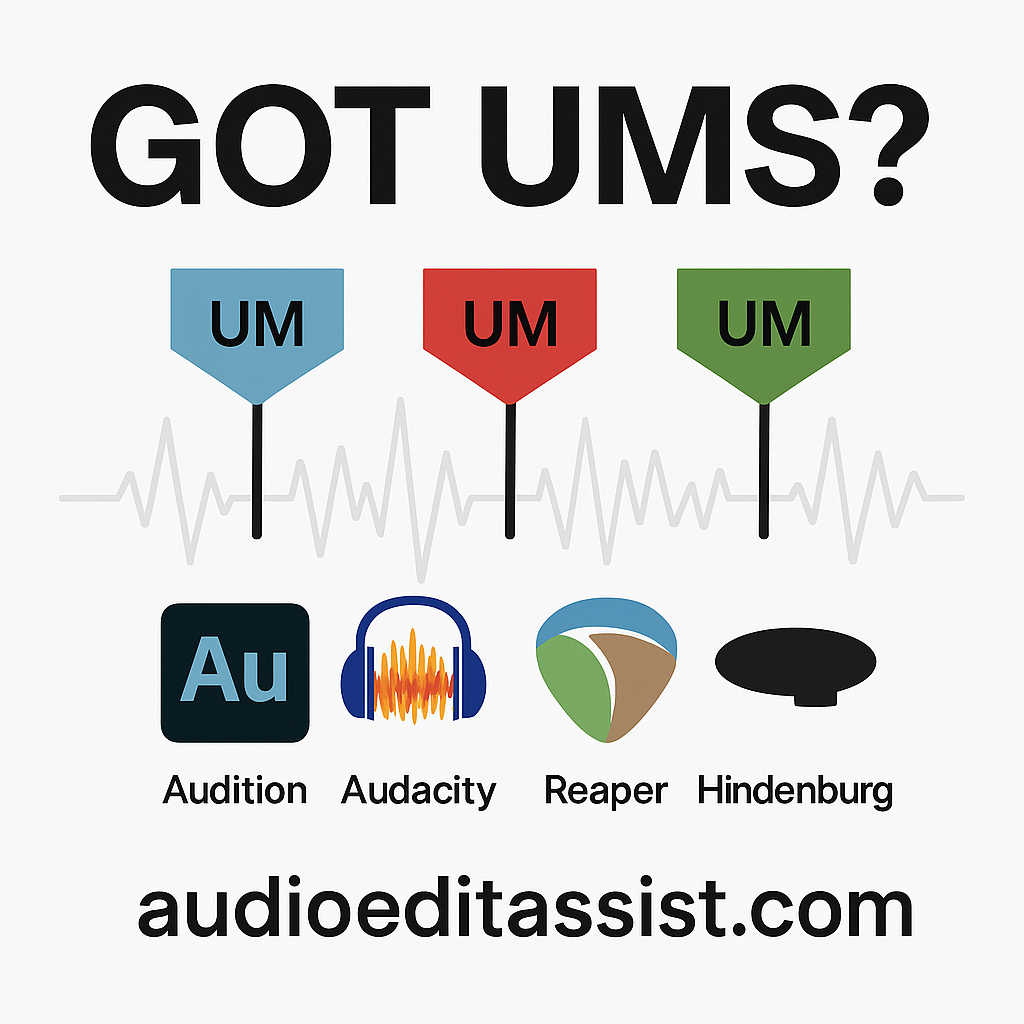
The Solution: This is exactly why services like Audiocore Edit Assist are a massive cheat code for producers. Instead of letting an unpredictable AI butcher your pacing, you can upload your raw files and get precise, DAW-compatible markers (compatible with Adobe Audition, Audacity, Reaper, or Hindenburg) flagged right over your waveforms within 24 hours.
This approach gives you the best of both worlds:
It protects your narrative pacing and humanity by letting you make the final executive decision on what to cut.
It eliminates listener fatigue and bypasses professional biases by letting you target and purge the worst 60–80% of filler clusters in a fraction of the time.
TL;DR: In real life, filler words protect your turn to speak. In recorded media, they just cause audience fatigue and quietly chip away at your authority. Don't let an AI completely sterilize your voice, but don't waste hours editing manually either—use a targeted marker service like Audiocore to clean up the fluff and keep your audience locked in.
Check out Audiocore Edit Assist to keep your filler words in check: https://www.knvpstudios.com/audiocore
